
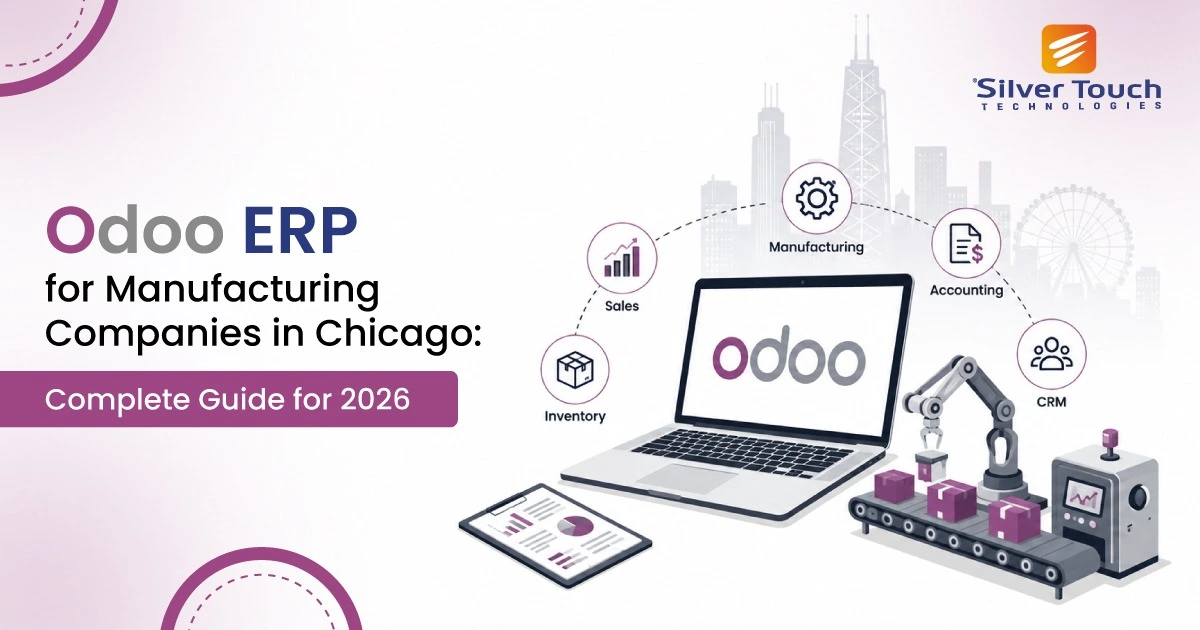
Chicago has long been one of America’s manufacturing powerhouses. From metal fabrication and food processing to industrial machinery, plastics, and electronics, thousands of manufacturers ac ross Cook County and the greater Chicagoland area depend on tight production planning, accurate inventory, and lean operations to stay competitive. Rising material costs, tighter margins, and persistent labor shortages have only raised the stakes. In 2026, more of those companies are replacing spreadsheets and disconnected software with a single, integrated platform – and Odoo ERP for manufacturing companies in Chicago has become one of the most talked-about options.
This complete guide breaks down what Odoo manufacturing software actually does, what’s new in Odoo 19 for 2026, the benefits for Chicago manufacturers, how it compares to other ERP options, realistic pricing, a practical implementation roadmap, and how to choose the right local partner.
Why Chicago manufacturers are turning to Odoo ERP
Manufacturers lose an average of around 20 percent of productive time to poor production planning and disconnected systems. In a high-cost, high-competition market like Chicago, that lost time goes straight to the bottom line. When purchasing, inventory, production, quality, and accounting all live in separate tools, data gets re-keyed, orders slip, and leaders make decisions on stale numbers.
The problem compounds as a business grows. A small job shop might survive on QuickBooks plus a handful of spreadsheets. But add a second shift, a new product line, or a demanding OEM customer, and those cracks widen fast: inventory counts drift, quoted lead times become guesses, and month-end close turns into a scramble. For many Chicago manufacturers, the trigger to move is not a single failure but the slow realization that their systems can no longer keep pace with the business.
Odoo ERP solves this by bringing every process into one connected system. Instead of juggling QuickBooks, spreadsheets, and a standalone MRP tool, a Chicago manufacturer can run material planning, work orders, shop-floor execution, quality control, and financials from the same database. Because Odoo is modular, you plug in only the apps you need and add more as you grow – which is why it appeals to small job shops and mid-sized manufacturers alike.
What is Odoo ERP for manufacturing?
Odoo manufacturing refers to the production-management environment built inside the broader Odoo ERP ecosystem, powered by the Odoo MRP (Material Requirements Planning) module. It connects material planning, work-order execution, quality control, equipment maintenance, product engineering, and reporting in one place – eliminating the data silos that slow factories down.
Odoo comes in two editions: Community, which is free and open source, and Enterprise, which adds more apps, hosting options, and official support. Both are available in the cloud (Odoo Online, Odoo.sh) or on-premise, and both are accessible from any browser or mobile device – useful for supervisors moving between the office and the shop floor. This flexibility matters in Chicago, where you’ll find everything from single-facility fabricators to multi-site operations spread across the suburbs and into Indiana and Wisconsin.
Key Odoo manufacturing features for 2026
Here are the core Odoo MRP capabilities that matter most to manufacturers:/p>
Bill of Materials (BoM): Define your product recipe with components, quantities, and optional operations. Odoo supports multi-level BoMs, kits, and product variants for complex assemblies.
Work Orders, Work Centers & Routing: Break production into routing stages that run sequentially or in parallel, and control flow across machines, labor, and time. Operators can start, pause, and complete work orders from a tablet on the floor.
- Make-to-Order and Make-to-Stock: Flexible support for both production strategies, so demand-driven and inventory-driven flows can coexist within the same plant.
- Manufacturing Orders: Track everything from raw-material consumption to finished goods, triggered automatically by customer demand or reorder rules.
- Automated replenishment: MRP generates draft purchase orders or sub-manufacturing orders automatically when stock falls below defined thresholds, reducing both stockouts and overstock.
- Quality Control: Build quality checks and non-conformance workflows directly into production stages so defects are caught before they ship.
- Maintenance & PLM: Preventive and corrective maintenance scheduling for equipment, plus Product Lifecycle Management with versioned documents and engineering change control.
- Scrap and by-product accounting: Define expected losses, record scrapped components, and keep product costing accurate.
- Lot and serial traceability: Full genealogy for recalls, audits, and warranty tracking.
- Real-time inventory and warehouse management: Live visibility into stock, capacity, and costs for data-driven decisions.
Together these features can drive meaningful savings – some implementations report cost reductions of up to 30 percent from tighter planning and fewer disconnected systems.
What’s new in Odoo 19 for manufacturers in 2026
Odoo 19 is the current major version, released in October 2025 at the Odoo Experience event in Brussels, following Odoo’s predictable one-major-version-per-year cadence. As of 2026, the officially supported versions are Odoo 17, 18, and 19, with Odoo 20 expected around October 2026. The minor release Odoo 19.3 landed in May 2026 with 35+ module improvements. Several are especially relevant to Chicago manufacturers:
- AI agents: Odoo 19 introduces AI agents throughout the platform that can create and update records autonomously – including pulling data from uploaded PDF files such as supplier documents and purchase orders. This cuts manual data entry across purchasing and production.
- Redesigned Manufacturing Kanban: A cleaner, faster shop-floor view that makes it easier to track manufacturing orders at a glance and spot bottlenecks early.
- Offline-first mobile mode: Field and floor workers can create, edit, archive, and delete records without an internet connection; changes sync automatically when connectivity returns – handy in older facilities with patchy Wi-Fi.
- 50+ industry packages and ESG reporting: Pre-built configurations plus built-in Environmental, Social, and Governance reporting, increasingly important for manufacturers supplying larger US customers and complex supply chains.
- Faster interface: OWL-powered navigation, compact Kanban views, and drag-and-drop list editing reduce clicks and speed up everyday tasks.
For manufacturers, the redesigned Manufacturing Kanban and offline mode alone often justify an upgrade in 2026. If you’re currently on Odoo 16 or earlier – which is no longer officially supported – planning that upgrade should be a near-term priority to keep security patches and migration tools available.
How Odoo compares to other manufacturing ERP options
Chicago manufacturers evaluating ERP typically weigh Odoo against entry-level tools like QuickBooks with add-ons, mid-market suites, and heavyweight platforms. Odoo’s differentiators are its modularity, open-source foundation, and lower total cost of ownership. Where many traditional ERPs charge steep per-module license fees and lengthy, expensive implementations, Odoo lets you start with Manufacturing and Inventory and expand only when you’re ready.
That said, Odoo is not a magic bullet. Highly specialized or heavily regulated environments may need careful customization, and the quality of your implementation partner makes an enormous difference. The honest comparison: Odoo offers exceptional breadth and value for small-to-mid manufacturers, while very large enterprises with deeply complex processes should scope requirements carefully before committing.
Benefits of Odoo ERP for Chicago manufacturing companies
Adopting Odoo manufacturing software delivers several practical advantages for a Chicago-based operation:
- One source of truth. Production, inventory, purchasing, quality, and accounting share the same live data, so everyone works from the same numbers.
- Better on-time delivery. Accurate MRP planning and automated replenishment reduce stockouts and late orders – critical when supplying demanding OEMs.
- Lower operating costs. Less waste, fewer errors, and reduced manual work free up both cash and staff time.
- Scalability. Start with Manufacturing and Inventory, then add CRM, e-commerce, HR, or Accounting as you grow – no rip-and-replace later.
- Compliance and traceability. Lot and serial tracking supports recalls, audits, and the traceability requirements common in food, pharma, and regulated manufacturing across Illinois.
- Local and remote access. Browser and mobile access keep multi-site operations connected across Chicagoland and beyond.
- Data-driven decisions. Real-time dashboards give owners and plant managers visibility into throughput, costs, and capacity without waiting for month-end reports.
- Configuration and customization. Set up work centers, BoMs, routings, and any industry-specific fields your floor requires.
- Data migration. Clean and import items, BoMs, vendors, and inventory balances – dirty data is a leading cause of go-live problems.
- Testing and training. Pilot with a small group, validate against real orders, and train operators on the shop-floor and mobile views.
- Go-live and support. Launch in phases where possible, then optimize as you learn. Plan ahead for version upgrades so you stay on a supported release.
Odoo ERP pricing for manufacturers
Odoo uses a subscription model based on the number of users, with all apps available for one price on Enterprise plans. Entry-level online plans start as low as around $25 per month, while more fully featured plans start near $95 per month for a small team; larger enterprise deployments are quoted based on user count and requirements. The Community edition is free to license, though most manufacturers budget for implementation, customization, hosting, and support.
When evaluating total cost of ownership, weigh the license fee against the efficiency gained across production, inventory, and quality – that’s where the real return shows up. A useful way to frame it: if Odoo helps recover even a fraction of the productive time typically lost to poor planning, the platform often pays for itself within the first year.
Odoo implementation: a practical roadmap
A successful rollout is less about software and more about method. A typical path for a Chicago manufacturer looks like this:
Discovery and process mapping. Document your real workflows – BoMs, routings, quality checks, and pain points – before touching the system. Solution design. Decide which modules to deploy first (usually Manufacturing, Inventory, and Purchasing) and how they connect to accounting and sales.
Choosing an Odoo implementation partner in Chicago
Software is only half the equation. Most failed ERP projects fail on implementation, not on features. The right Odoo implementation partner in Chicago will map the platform to your specific production environment – your floor, your BoMs, your routings – rather than forcing a generic demo workflow onto your business.
Look for a certified Odoo partner with real manufacturing experience, a structured implementation methodology, local availability for training and support, and a clear plan for data migration and version upgrades. Ask for references from other manufacturers, and make sure the partner understands your industry’s compliance needs. A strong partner turns Odoo into a competitive advantage; a weak one turns it into a multi-month disruption.