
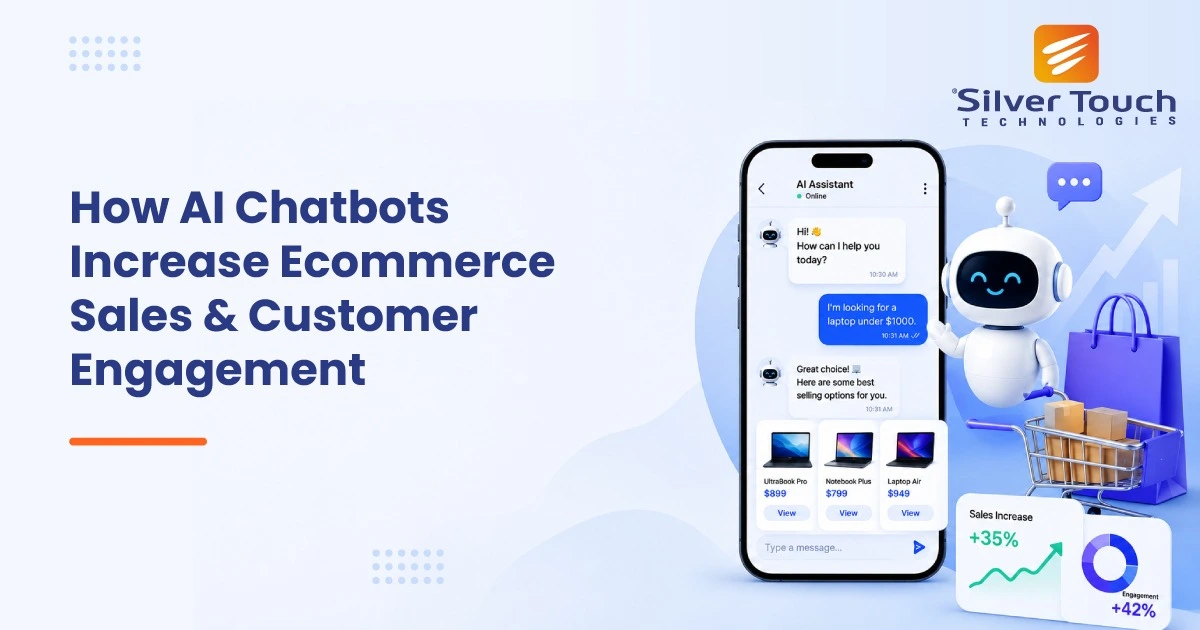
If you have ever abandoned an online shopping cart because you could not get a quick answer, you already understand the problem. American online shoppers expect fast, helpful responses and they expect them right now. According to Tidio, 62% of consumers would prefer to use a chatbot rather than wait for a human agent when asking simple questions. That is not a small number. That is the majority of your potential customers choosing speed over everything else.
AI chatbots for ecommerce have moved far beyond scripted bots. Today’s tools are powered by large language models, real time product data, and behavioral analytics, making them capable of guiding a shopper from “just browsing” to “order confirmed” without a single human rep involved. They do not take breaks, they do not get overwhelmed during peak season, and they get smarter the more they are used.
In this post, we will walk through exactly how AI chatbots increase ecommerce sales and customer engagement, why US based online retailers are investing heavily in this technology, and what results you can realistically expect when you deploy one the right way.
Why Ecommerce Businesses in the USA Are Turning to AI Chatbots
The US ecommerce market crossed $1.1 trillion in sales in 2023 (U.S. Census Bureau), and competition for customer attention has never been fiercer. Shoppers now bounce between Google, Instagram, TikTok, and your website, often within minutes of each other. Holding their attention and converting that intent into a completed purchase requires more than a great product page and a fast checkout.
Here is the reality most store owners are dealing with right now:
- High cart abandonment rates the average sits around 70% across US ecommerce sites, according to the Baymard Institute. That is seven out of ten people who showed genuine purchase intent walking away.
- Rising customer acquisition costs paid ads are getting more expensive every year while organic reach continues to shrink. Getting shoppers to your site costs more; losing them on arrival costs even more.
- Overwhelmed support teams handling hundreds of repetitive queries per day eats into time and budget that could be spent on growth focused work.
- Low repeat purchase rates one time buyers rarely come back on their own without a timely, relevant reason to return.
AI chatbots address all four of these pressure points simultaneously. They engage visitors before they leave, recover abandoned carts in real time, handle support at scale around the clock, and create personalized reengagement moments that bring shoppers back for a second and third purchase. That is a meaningful return on a single technology investment.

Key Ways AI Chatbots Drive Ecommerce Sales
1. Proactive Engagement That Captures Intent Early
Most visitors land on your store, scroll for a minute or two, and leave, often without giving you any signal about what they were looking for. A well configured ecommerce chatbot changes that dynamic entirely by initiating conversations based on behavioral triggers: time on page, scroll depth, product category visited, items added then removed from a cart, or exit intent detected at the cursor level.
Instead of waiting passively, the chatbot steps in at exactly the right moment: “Looking for something specific? I can help you find the right size, compare similar products, or check whether your preferred color is in stock.” That single, well timed touchpoint can turn a passive browser into an engaged buyer within seconds.
Studies from Intercom and Drift show that proactive chat messages increase engagement rates by up to 30% compared to reactive only support. When you multiply that lift across thousands of monthly visitors, the revenue impact becomes very real, very fast.
2. Personalized Product Recommendations at Scale
One of the biggest advantages AI chatbots bring to ecommerce is the ability to deliver genuinely relevant product suggestions, not generic “you might also like” blocks, but context aware recommendations based on what the shopper has browsed, bought before, spent time reading, or asked about in the chat itself.
This is the same logic that powers Amazon’s recommendation engine. The difference is that this capability is now accessible to mid market US retailers through platforms like Tidio, Gorgias, and Intercom, without enterprise level budgets.
Rather than showing every shopper the same bestsellers list, the chatbot curates a shortlist in real time: “Based on what you have been looking at, here are three products our customers usually pair together.” Personalization at this level typically lifts average order value (AOV) by 10 to 30%, according to McKinsey and Company. For a store doing $50,000 a month, that is a $5,000 to $15,000 revenue increase with no additional ad spend.
3. 24/7 Customer Support Without Scaling Your Headcount
American shoppers do not just buy during business hours. Late night browsing, early morning impulse purchases, and weekend shopping rushes all happen outside the regular window and every unanswered question during those hours is a potential sale that slips away.
An AI chatbot handles the full range of routine support interactions automatically and instantly, including:
- Order status and shipping tracking with real time updates without a human touching the conversation
- Return and refund policy explanations and initiation
- Size guide and product specification questions
- Discount code validation and application at checkout
- Payment troubleshooting for common errors and declined transactions
- Stock availability checks across variants and SKUs
According to Salesforce, deploying an AI chatbot reduces inbound support ticket volume by up to 40%. That frees your human support team to focus on complex, high stakes interactions like escalations, large orders, and VIP customers, where a real person genuinely adds value. For growing US ecommerce brands managing lean teams, this is an operational breakthrough.
4. Abandoned Cart Recovery in Real Time
Cart abandonment is the single biggest revenue leak in ecommerce, and the traditional fix, a recovery email sequence, has a fundamental timing problem. By the time your first email lands in a shopper’s inbox, their purchasing mindset has already shifted. They have closed the tab, moved on, and forgotten why they were excited about your product in the first place.
AI chatbots can intervene in the moment, before the shopper ever leaves the page. When a user shows exit intent signals on the cart page, the chatbot fires immediately with a targeted, helpful message rather than letting the session end silently. The recovery playbook looks something like this: offer a time limited incentive (“Complete your order in the next 15 minutes and we will take 10% off”), address the most common hesitations (“Questions about our return policy or delivery time? Ask me right now”), or surface social proof that reinforces the purchase decision (“Over 3,000 customers bought this item in the last 30 days. Here is what they said”).
According to Klaviyo, real time cart recovery tools reclaim 5 to 15% of abandoned carts. For a store with $100,000 in monthly revenue losing 70% of carts, recovering even 8% of that abandoned revenue adds roughly $5,600 back every single month.
5. Seamless Omnichannel Presence Across Every Touchpoint
Today’s US shoppers move fluidly across channels and devices. They might discover your brand through a TikTok ad, research the product on your website, ask a question via Instagram DM, and complete the purchase three days later on their laptop. Each of those touchpoints is an opportunity and a potential drop off point if the experience is not consistent.
Modern AI chatbots integrate across all of them: your website, SMS, WhatsApp, Facebook Messenger, Instagram, and email, maintaining full conversation context regardless of where the shopper picks up the thread. A customer who asked about sizing on Instagram can continue that conversation on your website without repeating themselves. That kind of connected experience builds trust and reduces the friction that kills conversions.
This omnichannel consistency also gives your marketing team a richer dataset. Every chatbot interaction generates behavioral signals about what people ask, what makes them hesitate, and what objections come up before a purchase. All of that can directly inform your product pages, ad copy, and email strategy.
How AI Chatbots Build Long Term Customer Engagement
Getting a first sale is hard. Getting a second sale is where the real profitability of an ecommerce business lives. Customer acquisition costs continue to rise, but the cost of reengaging an existing buyer is a fraction of finding a new one. AI chatbots are uniquely positioned to own this post purchase relationship in a way that feels personal rather than automated.
After an order ships, the chatbot checks in proactively by confirming delivery, asking for feedback, and suggesting a complementary product while the customer is still in a positive frame of mind about their purchase. When a loyalty reward threshold is reached, the chatbot notifies the customer immediately rather than waiting for them to discover it on their own. When a product the customer viewed but did not buy comes back into stock or drops in price, the chatbot is the one delivering that news first.
These are not gimmicks. They are systematic relationship building touchpoints that compound over time. Brands that execute this well see measurable improvements in customer lifetime value (LTV), net promoter scores (NPS), and repeat purchase frequency, the three metrics that determine whether an ecommerce business scales sustainably or stalls.
The Real ROI of AI Chatbots for US Ecommerce Brands
Let us bring this down to numbers, because that is what matters in a business context. When you stack up the impact areas including proactive engagement lifting conversion rates, personalized recommendations increasing AOV, 24/7 support reducing ticket volume and labor costs, and real time cart recovery reclaiming lost revenue, the ROI calculation becomes compelling quickly.
Most US ecommerce brands that deploy AI chatbots report seeing positive ROI within 60 to 90 days. The platforms themselves are far more accessible than they were even three years ago. Mid market tools like Tidio, Gorgias, and Intercom offer plans starting under $50 per month with native integrations for Shopify, WooCommerce, and BigCommerce. Enterprise grade deployments with custom AI training and deep CRM integration cost more, but the scalability they unlock, handling thousands of simultaneous conversations without additional headcount, more than justifies the investment for high volume stores.
The brands winning in US ecommerce right now are not necessarily the ones with the biggest ad budgets. They are the ones converting more of the traffic they already have, keeping more of the customers they have already acquired, and doing both at a cost structure that lets them grow profitably.
Conclusion
The question for US ecommerce businesses in 2025 is not whether to use AI chatbots. It is how quickly you can get one deployed and working effectively. The data is consistent across the industry: businesses using AI chatbots for ecommerce see measurable improvements in conversion rates, average order values, support efficiency, and long term customer retention. In a market where margins are tight, customer expectations are high, and every click costs money, an AI chatbot is not a nice to have feature or a flashy tech experiment. It is core infrastructure. It works while you sleep, scales without hiring, and delivers the kind of fast, personalized, always on experience that today’s American shoppers have come to expect as the baseline, not a bonus.
Start where it makes the most immediate business sense. If cart abandonment is your biggest leak, deploy a recovery bot first. If support costs are eating your margins, start with 24/7 automated service. Build from there. The brands that treat AI chatbots as a growth lever rather than just a support tool are the ones pulling ahead of the competition, and the gap is only going to widen from here.