
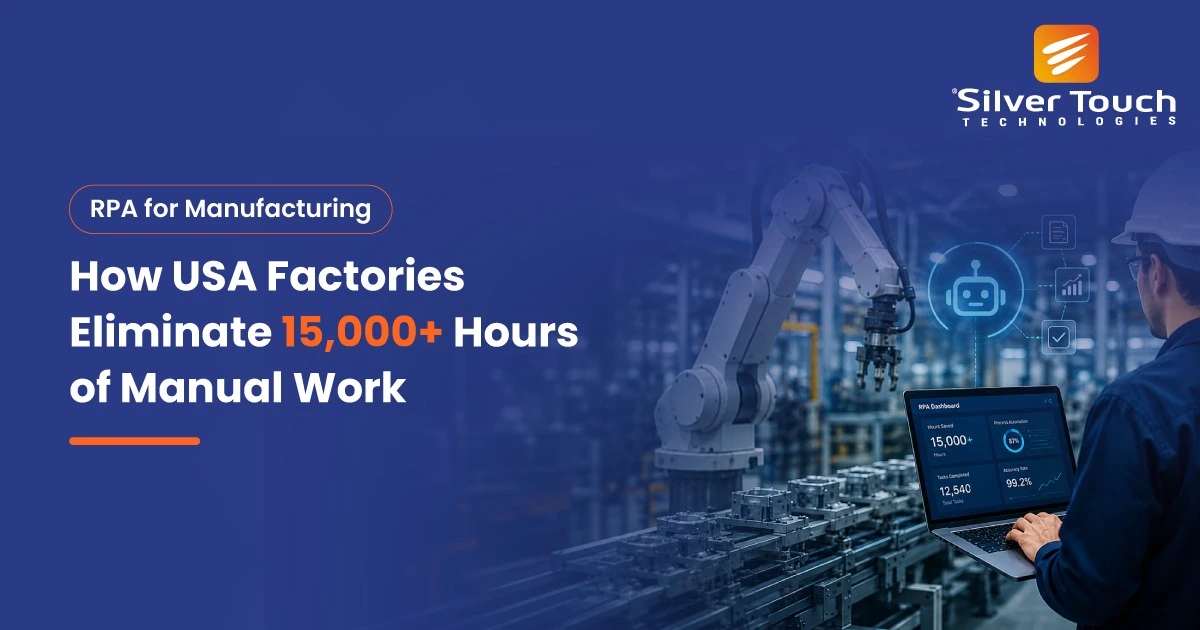
Walk into any mid-size American manufacturing plant and you will find something remarkable. On the production floor, machines run around the clock — precise, tireless, and consistent. But walk into the back office and you will often find a different picture entirely: a team of skilled people manually entering purchase orders, pulling data from three separate systems to build a quality report, matching invoices line by line, and keying shipment confirmations into a customer portal — one by one, all day, every day.
This gap between an automated factory floor and a manual back office is costing USA manufacturers more than most leadership teams realize. And in 2026, it is no longer a problem you need to simply accept.
As a leading RPA service provider company, Silver Touch Technologies helps manufacturers streamline operations through intelligent automation. Robotic Process Automation (RPA) is the technology that closes operational gaps by deploying software bots that work across your existing applications, handling repetitive, rule-based tasks your teams should never have to do manually. This guide explains how RPA is being deployed across USA manufacturing and wholesale distribution, what the real ROI looks like, and how businesses can get started in as little as 8 weeks.
What Is RPA, and Why Does Manufacturing Have the Highest ROI of Any Industry?
RPA stands for Robotic Process Automation. Unlike physical robots on a factory floor, RPA bots are software — they sit on your existing systems and replicate the actions a human employee would take: logging into applications, reading data, filling forms, moving information between systems, and generating reports. No custom API integrations required. No replacing your ERP. Bots work with whatever software you already have.
Manufacturing is the single highest-ROI industry for RPA deployment, and the reason is straightforward: no other sector has the same density of high-volume, rule-based, repetitive processes running across so many systems simultaneously. The average mid-size USA manufacturer has between 12 and 18 processes that qualify for immediate RPA deployment without any business process redesign.
The math is equally compelling. A single RPA bot handles the equivalent workload of 3 to 5 full-time employees — at roughly 15 to 20 percent of the fully loaded labor cost. For a manufacturer spending $280,000 per year on 4 back-office employees handling repetitive data tasks, the right RPA deployment often recovers $200,000+ annually within the first 12 months.
The 6 Highest-ROI RPA Use Cases for USA Manufacturers in 2026
These are not theoretical. These are the six processes where USA manufacturing and wholesale distribution companies are deploying RPA today and achieving the fastest payback.
1. Purchase Order Processing
This is the most common RPA deployment in manufacturing — and the one with the most immediate payback. Bots read incoming purchase requisitions, validate them against approved vendor lists and budget codes, generate POs in your ERP (SAP Business One, SAP S/4HANA, Odoo, or any other system), and send confirmation to the vendor — all without a human touching it. Average time per PO drops from 12–18 minutes of human handling to under 90 seconds.
2. Quality Control Reporting
Quality teams in USA manufacturing plants spend a disproportionate amount of their time not doing quality work — but doing quality paperwork. Pulling inspection data from multiple systems, cross-referencing against specifications, and manually populating compliance reports consumes hours every day. An RPA bot handles all three steps automatically, generating a complete, audit-ready QC report and routing it to the right reviewer every shift, every day — without any manual effort.
3. Three-Way Invoice Matching (Accounts Payable)
Matching purchase orders, goods receipts, and vendor invoices manually is one of the most labor-intensive and error-prone processes in any manufacturing back office. A single discrepancy triggers a chain of emails, corrections, and re-approvals that can delay payment for days. RPA bots perform the three-way match automatically, flag genuine exceptions for human review, and process clean matches straight through. AP teams typically see a 70–85% reduction in manual handling time.
4. Production Data Entry and ERP Updates
When production supervisors update work orders, material consumption, and output quantities, that data typically needs to flow from a shopfloor system, a paper form, or a spreadsheet into your ERP. When it doesn’t happen in real time — because someone gets busy, a shift ends, or the system is slow — your MRP runs on stale data. That stale data drives wrong purchase orders, wrong delivery commitments, and wrong inventory counts. RPA bots sync this data automatically, keeping your ERP accurate in real time without requiring anyone to remember to do it.
5. Inventory Reconciliation
Multi-warehouse manufacturers frequently run inventory reconciliation manually — comparing physical counts against ERP records, investigating discrepancies, and updating master data. Bots can automate the comparison and discrepancy flagging, reducing the time your warehouse team spends on reconciliation by 60–75% and eliminating the spreadsheet-based workarounds most teams rely on between full physical counts.
6. Customer Order Acknowledgment and Shipment Confirmation
When a customer order lands via EDI, email, or a customer portal, someone has to enter it into your system, confirm availability, generate an order acknowledgment, and — after shipment — update the portal with tracking information. For high-volume distributors and manufacturers, this process consumes entire full-time roles. RPA handles every step from order receipt to shipment confirmation, reducing the customer service desk workload by 50–70% on routine orders.

What Does RPA ROI Look Like for a Real USA Manufacturer?
Numbers matter. Here is a representative example from a USA discrete manufacturer that deployed RPA across three processes in 2026.| Process Automated | Annual Labor Hours Saved | Annual Cost Saved | Error Rate Reduction |
|---|---|---|---|
| PO Processing | 4,800 hrs | $168,000 | 94% |
| QC Report Generation | 2,600 hrs | $91,000 | 99% |
| AP Invoice Matching | 3,100 hrs | $108,500 | 97% |
| TOTAL (3 bots) | 10,500 hrs | $367,500 | 96% avg |
Total bot deployment cost: $64,000. Payback period: 5.2 months. Year-1 ROI: 474%.
This is not an outlier. Across manufacturing and wholesale distribution deployments, the average payback period is 5 to 7 months, and the average first-year ROI runs between 280% and 500% — depending on labor costs, process volume, and the number of bots deployed.
The Simple ROI Formula Your CFO Needs to See
Before any RPA pilot, you need a number. Here is the formula:
RPA ROI Formula
- Annual Savings = (Daily Transactions x Minutes per Transaction x Hourly Labor Rate x 250 working days) / 60
- Net ROI = Annual Savings minus Annual Bot Cost
- Payback Period = Bot Cost divided by Monthly Savings
- Example: 400 POs/day x 15 min x $38/hr fully loaded x 250 days / 60 = $950,000 gross annual savings
A fully loaded hourly rate for a USA back-office employee in manufacturing typically runs $35 to $55 per hour (salary plus benefits, payroll taxes, office overhead, and management cost). Use your actual number. The result is almost always a compelling business case.
The 8-Week RPA Deployment Roadmap
One of the most common misconceptions about RPA in manufacturing is that it requires a lengthy, disruptive implementation project. It doesn’t. A focused, well-scoped RPA deployment follows this timeline:
Weeks 1–2: Process Discovery
Map your top 5 candidate processes with your operations and finance teams. Capture transaction volumes, time per transaction, error rates, and the systems involved. This single step separates successful deployments from failed ones — most project overruns trace back to skipping proper scoping.
Weeks 3–4: Bot Design and Development
Your RPA partner designs the bot logic for each process and builds it in your chosen platform (UiPath, Automation Anywhere, or Microsoft Power Automate). All development happens against a sandbox environment — your production systems are not touched.
Weeks 5–6: Testing and User Acceptance
Bots run against real data scenarios including edge cases and exceptions. Your operations team validates outputs. Exception handling — what the bot does when something unexpected happens — is refined until your team is confident.
Weeks 7–8: Go-Live and Monitoring
Bots deploy to production. A monitoring dashboard shows you bot performance, transaction volumes, error rates, and exception queues in real time. Your team gets training on reviewing exceptions and escalating edge cases. A hypercare period covers any post-go-live issues immediately.
Choosing the Right RPA Platform for Your Manufacturing ERP
The platform question is genuinely secondary to the process question — but it matters. Here is a brief guide for the three platforms USA manufacturers most commonly use:
- UiPath:
- Automation Anywhere:
- Microsoft Power Automate:
The most widely deployed enterprise RPA platform globally. Excellent for complex manufacturing workflows with multiple system integrations. Best for companies planning to scale to 10+ bots. Integrates natively with SAP Business One, SAP S/4HANA, and Odoo.
Strong in regulated manufacturing (pharma, food & beverage) due to its compliance and audit trail capabilities. Cloud-native architecture suits manufacturers already on Azure or AWS.
Best value for manufacturers already using Microsoft 365. Straightforward for simpler, document-centric processes. Less suited to complex multi-system manufacturing workflows but an excellent starting point for companies new to RPA.
At Silver Touch Technologies, we are platform-agnostic — we recommend based on your existing ERP, IT environment, and process complexity, not on platform partnership incentives.

Why the Smartest USA Manufacturers Are Starting RPA Now
There is a compounding advantage to RPA that most companies do not account for in their initial business case. Every month you delay deploying a bot on a process you know needs automation is a month you are paying the full human cost of that process. There is no neutral position — you are either paying people to do robot work, or you have deployed a robot to do it at 15% of the cost.
The manufacturers we work with who deployed RPA in 2023 and 2024 have now recaptured their initial investment multiple times over. They are using the savings to fund growth, add skilled roles in engineering and product development, and invest in the next layer of intelligent automation — AI agents — that builds on top of the RPA foundation they have already established.
If you have not yet mapped your automation-ready processes, that is the place to start. Silver Touch Technologies offers a complimentary RPA Process Discovery session for USA manufacturing and distribution companies — a structured 60-minute workshop where we identify your top automation candidates and build the initial ROI model together, at no cost.